


When my story begins, I was living in Eretz Yisrael, with three cute, young children, eagerly awaiting the birth of my fourth child.
My husband was learning full-time, and I was teaching a few hours a day. It was just before Shavuos, and we were planning to host a large crowd of bochurim for the seudah — my brothers, brothers-in-law, and their friends.
On Erev Shavuos, I went for what I thought would be a quick and routine doctor’s appointment. But the doctor soon realized that something was wrong with the baby.
He told me the grim prognosis: spina bifida. According to him, this meant that the baby would be very sick — physically and mentally handicapped (a conclusion I later learned isn’t inherent to the diagnosis).
He kept shaking his head and saying how terrible, horrible, awful this was.
And then the appointment was over, and I was outside on the busy, bustling streets, in a rush to get home for Yom Tov. There were no taxis in sight, but I was only a twenty-five minute walk from home, no big deal, right?
Except it was 101 degrees.
But I had no options; I rushed home. There was so much to be done, and my mind was reeling from what I’d just heard.
When I walked in, my husband asked if everything was okay. I said no, not at all, but then I collected myself and decided to try to reach my regular doctor to get his opinion.
I was so frazzled that I called the doctor at home, and allowed the phone to ring and ring. Eventually, the doctor’s wife picked up the phone, and she was very upset. Without knowing why I was calling, she told me that the doctor works hard enough, and it was a chutzpah to call him at home so close to Yom Tov.
Left on our own, we had to try to tuck the news away and get ready for Shavuos. Usually, if a woman gets difficult news, she has the luxury of falling apart a little. She’ll cry, spend the day in bed, wallow in the helplessness and anxiety and fear. Here, I just had to step up and make Yom Tov — for a houseful of guests, no less.
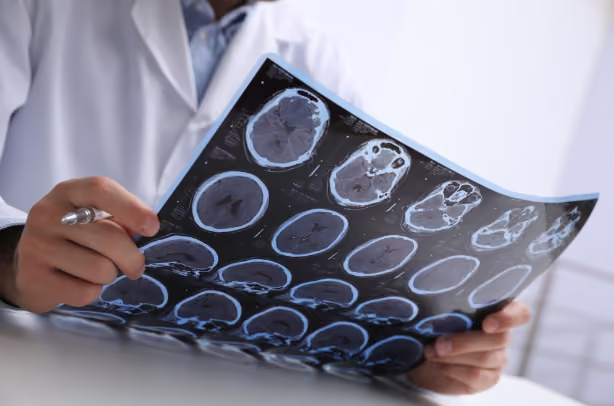
As I moved through the day, the words kept playing in my mind. Spina bifida, spina bifida. This meant there was a hole in the back of the baby’s spine, and delicate nerves were exposed or outside the spinal column.
What I didn’t know was that spina bifida can lead to different levels of paralysis — depending where on the spine the hole was, and how many nerves were exposed. I also had no idea that the doctor was wrong in assuming a mental handicap.
That day, all I had was a memory of volunteering as a teen to visit a woman with spina bifida. She had a very bad case, and although she was in her thirties, she was on the cognitive level of a three-year-old. The thought of raising a child like that was terrifying.
Without any access to medical advice for the time being, my husband went to his mashgiach for advice. “Don’t talk about it, don’t think about it,” the mashgiach told him. “Hashem is great and you’ll have a healthy child.”
He advised us to not even tell our parents until we traveled from Eretz Yisrael to give birth in the States. “Miracles can happen when things are concealed. You’ll have much nachas from this baby,” he said.
When Yom Tov was over, we galvanized into action — all on our own. We had to get a better insurance policy, better doctors, and arrange to give birth in CHOP in Philadelphia rather than in the hospital near my parents’ home.
At the same time, we came to the realization that having a child with special needs would mean we’d have to move back to the United States, so there were all those arrangements to take care of as well.
While I was consumed with the practical and technical details, my husband was busy going to every rav, rebbe, and kever he could think of, receiving beautiful brachos and davening for the health of our baby. The full-time learner was now a full-time davener, because it had never felt more needed.
As I came closer to my due date, I returned to the doctor for the first time since that fateful Erev Yom Tov, this time to request a letter for the airline to allow me to fly. Until then, we followed the advice of our rav and didn’t go for a single appointment. In a way, it was a nice “vacation” from the medical side of things, although mentally, I didn’t have a single second’s break. I was constantly picturing the worst scenarios and it was difficult to stay positive.
The doctor was shocked to see me. “Why are you still here? I was sure you flew straight back to the States. Go and get yourself a top doctor there!”
Once we got to the States, I did have to break the news to my parents. They were so supportive.
“If Hashem is giving you this, it means you can handle it,” they told me. “We’re here for you, we’ll take care of your other children, and help in any way you need. B’ezras Hashem, this child will be like any other grandchild.”
My parents accompanied me to my first appointment in CHOP. I sat down with this top doctor, so fancy he had two junior doctors at his side taking notes. I expected a long, thorough meeting; after all, we’d traveled two and a half hours to get there! But all he said was, “When you have the baby, I’ll tell you what I can do. Until then, there’s nothing to say.”
So we went home.
A week later, our baby was born — and a beautiful baby she was, with long black hair and a loud, gusty voice. The doctor said, “Wow, this looks like a really healthy baby! There’s nothing to worry about. She’ll shake up the world someday!”
Then they took her for testing.
I told my husband, “See? The rabbanim were right. There was nothing to worry about.”
But my husband had seen the baby immediately after birth, before she was wrapped up. He told me that her legs were in a strange position, and she definitely had a hole in her spine.
We realized that the fact that she was born healthy and crying loudly was a chesed. No tefillah is in vain, and surely the power of my husband’s tefillos in the months before the birth helped her be born strong, instead of sickly and lethargic.
When the doctors returned to talk to us about the spina bifida, they gave us a private room. “This is the mourning room, for mom and dad to cry in,” they announced solemnly.
We looked around the nicely decorated room, and we just burst out laughing. How can you push a button and say “cry”?
We were busy, it was Erev Rosh Hashanah, and there were a million things to arrange. We needed to figure out details of surgery, therapies, what care the baby would need. Yes, we cried many times along the journey — but not in that room.
A couple who had a child with spina bifida visited us there in the hospital. They talked about how wonderful and beautiful and rewarding it was to raise such a child. We had no patience to hear that. We couldn’t understand them — a healthy child is a dream come true; why make a big party over having a child with special needs?
Now, years later, we’ve grown to understand what they meant. But that day, Erev Rosh Hashanah, with the baby’s surgery looming, we just couldn’t comprehend their approach.
When she was just a day old, our daughter had surgery to close the hole in her back. She woke up calm, and didn’t seem to be in any pain. The doctor’s verdict was that she would be paralyzed from the waist down, and never be able to bend her knees.
The very next day, I was singing to the baby, and she started kicking her legs, bending both knees!
It turned out that, baruch Hashem, she was only paralyzed from the knees down — a huge difference.
We were discharged, and my mother encouraged me to rest, but I was on a mission: I wanted to call therapists, start early intervention services, and begin the process of casting and braces to straighten out the baby’s feet.
I was young and dumb — I shouldn’t have put that pressure on her with the surgical site still healing — but I was in a rush, I wanted things to heal and to progress as quickly as possible.
Baruch Hashem, the baby was cute, happy, and strong. I was busy with testing, therapies, braces and bars for her feet, and she kept growing and developing rapidly.
By fourteen months, Roizy could talk and move around — and even pull herself up to standing, with her strong upper body. Her feet, though, would collapse beneath her. She’d say to me, “Mommy, shmatte [junky] feet!” And then she’d burst out laughing.
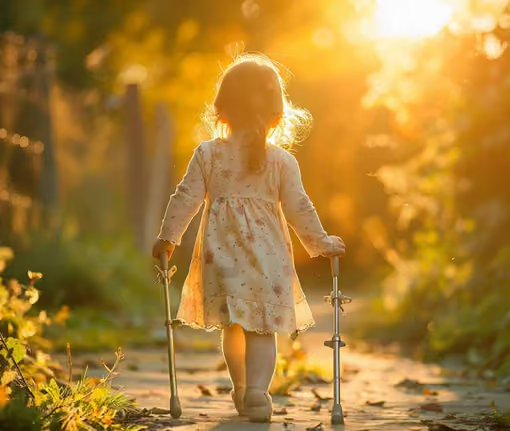
I could see that she desperately wanted to walk, so we bought her a stander and a walker to help her do it. By two years old, she could walk with crutches. She began school, a cute, fun-loving little girl with tons of personality. Her teachers kept telling me, “She isn’t handicapped!” She was bright, had a great attitude, and loved having a good time.
I remember one incident from when my daughter was three and a half. She was out walking, and another child, maybe six years old, made fun of her, saying, “Look, there’s an old babushka coming with a walker!”
The mother of the child sharply reprimanded her. But my three-year-old said to her, “It’s a good question! Why does a little kid have a walker?”
Roizy explained that elderly people sometimes have weak feet, so they use a walker, and she also has weak feet. She understood that it might look funny, and she was also able to confidently respond.
At the end of first grade, one girl was chosen from every grade to perform at an end-of-year event. And guess who was picked from her grade?
I called the teacher and said, “I appreciate that you want to make her feel good, but I simply don’t have time for this — creating a costume, props, practicing with her….”
The teacher said, “It’s not a favor for her, it’s a favor for me! She’s the only girl in the class talented enough to do it.”
So we sewed a costume and practiced her song, and there it was, her first public performance. As time went on, she’d come to give many more.
Our daughter grew up healthy and confident, not babied, not spoiled. She had chores around the house like everyone else. Every so often we had to do six weeks of casting to help her feet stay straight so she’d be able to walk with crutches, but that was just part of our reality. Sometimes, the school would call me and ask if they should change their regular program to accommodate her handicap, but I always said no. She had to live in the real world, and learn how to work with reality.
And our incredible daughter figured out how to join even activities like dancing! She’s very coordinated, and managed to figure out how to join the dance, skipping beats to keep up, putting her crutches in the air, singing at the mic if she couldn’t do one part of the dance… She was able to be a part of everything.
My older daughters were still young, and they doted on their younger sister. They loved bringing over friends and showing her off, so she was always the center of attention. They also enjoyed the special gifts and sibling events they were treated to. When the next baby came along, they asked, “Will this one also have spina bifida?”
It wasn’t always smooth sailing.
When the going got tough, we put on music and danced. We kept our home a happy place, and didn’t let the difficulties let this get us down.
When Roizy reached high-school age, things got a little more challenging. The school worked hard to accommodate her, but sometimes, the accommodations left her feeling singled out. We appreciated what they did, though, and the fact that her friends have so much sensitivity to her needs.
For example, the principal was concerned for her safety, and wouldn’t allow other girls to go on the stairs at the same time as her. Roizy wanted to be just like everyone else, however. She didn’t like feeling like she was different.
We also had a challenge with the bathrooms; Roizy needed her own so that there wouldn’t be a danger of slippery floors, but the school wanted to put a big handicapped sign on “her” bathroom, which would have mortified her. Luckily, my older daughter saw the sign first, and took it down.
Another time, she worked really hard to earn the most money for a tzedakah campaign — and the grand prize was a trip to a trampoline park.
Looking back, I see how much we all grew and are still growing from the experience. I try not to put pressure on my girls to help their sister; they’ll im yirtzeh Hashem be mothers themselves one day and I want them to have a burden-free childhood. But of course, there’s still an impact.
My older daughters sometimes get frustrated that people tell them how “special” they are. They brush it off. “It’s just strong arm muscles from always helping her,” they say.
But it isn’t true — we have grown, as a family, and as individuals.
Each situation is unique. Not everyone will have the same ups and downs as we did — and it’s normal to have more downs.
We remind ourselves constantly: Hashem loves her more than we do. And He gave her whatever she truly needs to fulfill her mission in life.
.avif)