



QUESTION:
Sometimes I feel like my children can't spend five minutes together without arguing. I try to be fair, but somehow, I always end up caught in the middle, and the fighting never seems to stop. Is there something I should be doing differently? How can I help them get along without having to referee every disagreement?
ANSWER:
Sibling rivalry is part of family life. And while brothers and sisters in every family squabble, siblings of children with special needs face some specific challenges. We’ll talk about those in the next article in this series. But first, let's take a closer look at sibling rivalry itself — why it happens, what it means, and how we as parents can best handle it.
Although sibling rivalry is disruptive to peaceful family living, it is a defining developmental factor for children. Parents must fully understand sibling rivalry and the role it plays in children's development so that they can approach it with the correct mindset.
What’s the Source?
At its core, sibling rivalry is the competition between siblings for their parents’ emotional support and attention.
Think about it this way: The firstborn child enjoys the privilege of being the sole focus of doting parents. After some time, another child joins the family. From the parents’ perspective, this is a wonderful gift — a growing, happy family with enough love to go around.
But from the child’s perspective, there’s a loss of the emotional exclusivity they once had with their parents. Each additional child inevitably creates competition, as they take a portion of the parents’ attention and care — a reality that can be very difficult for young children to accept.
Sibling rivalry is an open manifestation of the friction that develops between children who are in constant competition for their parents' love and attention.
One clear indication of this is that sibling rivalry often diminishes once children marry. As each sibling develops a close, individual relationship with a spouse, the competition begins to fade. They can finally build friendships with their siblings in ways they couldn’t before.
Even more fascinating is that after fifty or so years of relative closeness, sibling rivalry can resurface when adult children begin caring for elderly parents or dividing a parent’s assets after their passing. Once the parents are once again involved, albeit passively, the sibling rivalry returns.
Although sibling rivalry may not be pleasant, it’s an indicator that the love the parents are transmitting to their children is worth fighting over, and it often reflects a fundamentally healthy family environment.
Reassure yourself with this reminder: children don’t fight in times of crisis.
The Benefits
The family structure — and the friction that multiple siblings naturally invite — actually benefits children. Children learn to cultivate critically important social-emotional skills such as sharing, coexisting, tolerating, and forgiving.
Through their interactions with siblings, some of which can be quite stormy, children learn that they are not, in fact, the center of the universe, regardless of what they may have believed, especially if they were the firstborn.
Slowly, over time, they refine the character traits that will ultimately support them in becoming unselfish spouses, giving parents, flexible coworkers, and effective leaders.
Love Unconditionally
Now that we understand the origins of sibling rivalry and the benefits it offers our children, it’s time to learn how to handle it properly.
One of the most effective ways to minimize sibling rivalry is to regularly demonstrate parental love. When children consistently feel cherished without having to compete for affection, they’re far less likely to see their siblings as a threat.
Tell your children how much they mean to you.
Point out their strengths. Name their talents. Praise their efforts.
Express your deep love constantly throughout childhood and adolescence, especially during private one-on-one moments.
There’s a well-known story that illustrates how powerful it is for a child to have complete confidence in their parents’ love and commitment.
After a devastating storm caused a building to collapse, a child was trapped beneath the rubble for two days. When he was finally rescued, he was asked how he had found the strength to survive under such difficult conditions.
He answered simply: his father had always told him that if he were ever lost, he would never stop searching for him. The boy knew his father was looking for him — and that certainty gave him the strength to hold on.
Rivalry vs. Jealousy
Every child is different, with their own personality, strengths, weaknesses, and talents.
Imagine, for a moment, that all the children in a family were exactly alike. Would they still experience sibling rivalry? Absolutely. They’d still compete for their parents’ attention, affection, and emotional support.
But what about sibling jealousy? That would be far less of an issue. After all, if every child had the same strengths, abilities, and talents, there’d be much less to envy.
And that’s where sibling jealousy differs from sibling rivalry.
While sibling rivalry is largely about competing for the same thing, jealousy is about wanting something someone else has. A child might envy a sibling’s talents, personality, achievements, or opportunities. One child may be naturally outgoing, while another struggles to make friends. One may excel in school, while another works twice as hard for the same grades.
In other words, children don't just compete with their siblings for their parents’ attention. They also notice what their siblings have that they don't — and sometimes wish those things were theirs.
The Tenth Commandment instructs us, “You shall not covet.” We’re obligated to resist desiring that which belongs to others, and we must teach our children to regulate those impulses as well.
What tool enables us to control jealousy?
Faith is the tool that enables us to trust that we’ve been given exactly what we need — no more and no less. If we don’t have something, we don’t need it.
When we rely fully on Hashem, jealousy loses its grip.
As parents, we must ensure that our behavior reflects trust in G-d. Be a role model of faith. Train your mind to shift automatically into the thought: “If I don’t have it, I must not need it.” This perspective applies not only to material possessions, but also to talent, success, and life circumstances.
Over time, your children will absorb the message as they watch you live it.
I observed the power of this mindset while driving one day with my sister.
“Mommy, do you see that big house on the corner over there?”Her teenage daughter piped up from the back seat. There was no ways my sister could have missed it. It was a big, beautiful house on a sprawling lot.
“That's Sarah’s house,” her daughter continued. “She has ten kids in her family and they each have their own room! Why can't we have a house like that? Why do we have to cram three kids into each one of our bedrooms?”
My sister’s immediate reply amazed me. “I’m so happy for Sarah and her family that they have a house like that. If we would need such a large house, G-d would give us one as well.”
What a lesson in faith — and in imbuing a crucial perspective in our children.
Stay Out of the Fight
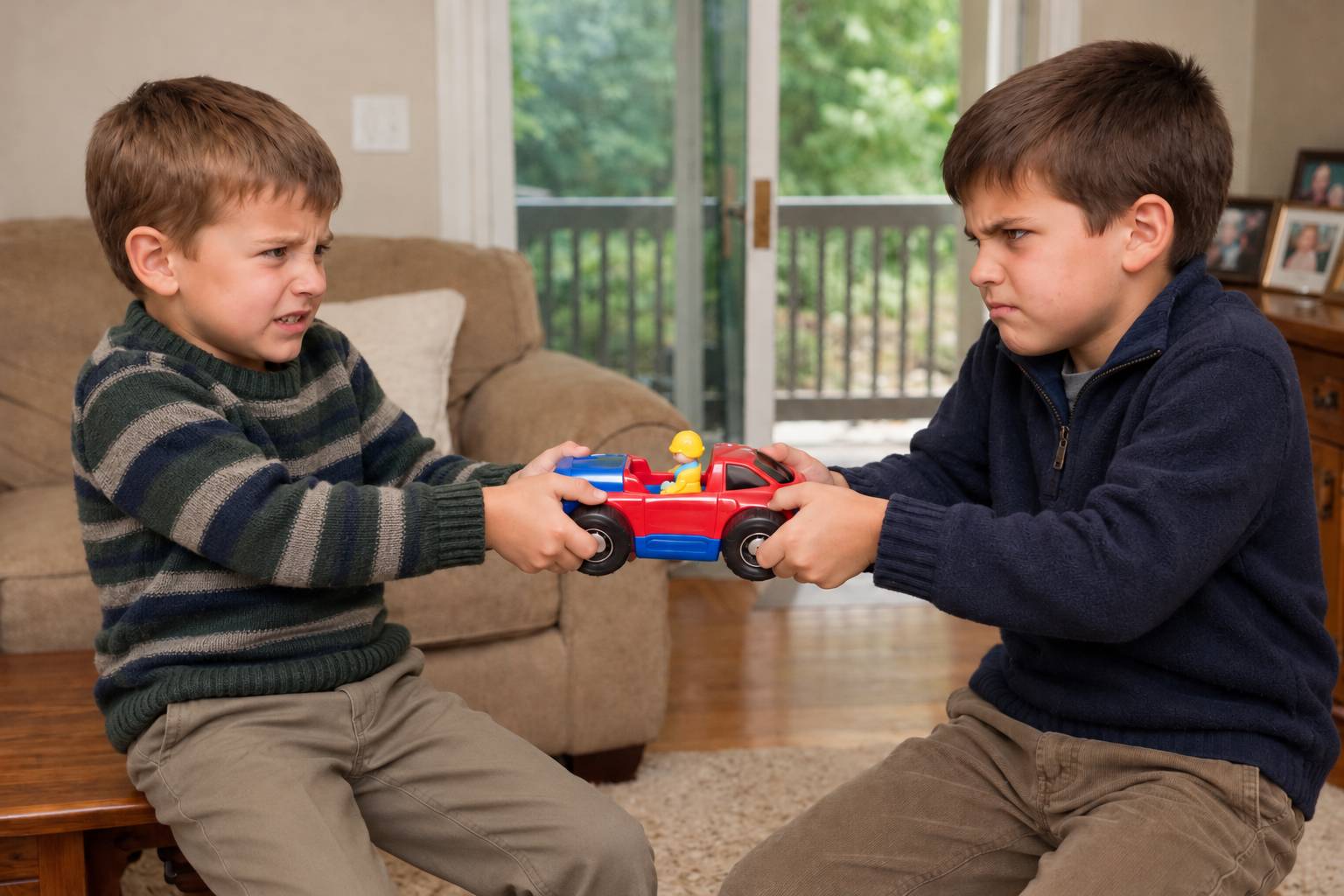
In order to gain parental attention, children fight and subconsciously hope the parent will side with them, thereby proving they are loved more. Even knowing there’s only a 50% chance of winning, a child will risk an argument for that extra dose of parental love and approval.
Although arguments seem to revolve around objects or events, children are actually fighting over which child the parent loves more. Parents must not encourage this rivalry by taking sides. When a parent sides with one child, the other may feel deeply hurt and look for another opportunity to win. The validated child may also initiate conflict to relive that boost of love. Parental involvement, though well-intentioned, often fuels more fights.
Put down your gavel. There is no need to don a judge’s robe.
Children shouldn’t grow up constantly seeking justice. Life doesn’t function that way. As adults, we understand that we need to work things out ourselves. Our children must learn to resolve quarrels independently — regardless of who is right or wrong. Sibling rivalry diminishes when children develop the emotional flexibility and problem-solving skills to navigate conflict on their own.
It’s normal for children to struggle with sharing their parents’ emotional support. They are entitled to wish they were the only child at times.
Instead of feeling upset when your children demand exclusive love, recognize it for what it is: a compliment. What greater proof is there that you are building a loving home than children willing to compete for your love?
Reacting to sibling rivalry
Now that we understand why our children fight, we must react appropriately to their fighting so as not to exacerbate the sibling rivalry and cause further episodes to occur. When you observe your children fighting with each other, take the following steps:
- Observe and listen. Try to understand what your children are fighting about and if there’s any danger, without asking questions.
- If the situation isn’t dangerous, stay out of it. It is best for the children to mediate their differences on their own. This helps them develop important life skills.
- If the situation involves physical aggression or seems to be escalating out of control, use the Separate Without Comment (SWC) approach to separate the children and maintain the separation gently and without comment until both parties have calmed down.
- If your children bring the argument to you and ask you to play judge, explain that you can’t take any child’s side, as that would hurt the other one. Share that you love them each so much, and don’t want to hurt them, so you’re trusting them to work it out themselves.
- Continue what you were doing. The fighting will eventually stop and the children will resolve the dispute on their own.
Bickering or Bullying?
It’s important for parents to differentiate between normal sibling rivalry and bullying so that it doesn’t worsen or interfere with the child’s other relationships.
Bullying involves the use of force or coercion to abuse or intimidate others. It often includes a pattern of behavior marked by an imbalance of social or physical power. In children, bullying occurs when one child repeatedly directs this behavior toward a specific victim who does not defend himself because he’s weaker than, excessively frightened by, or younger than the aggressor.
To address bullying, step by step:
- Carefully observe the fighting. Take note of which child initiates the fight, who is the victim, and what the victim’s response is. Keep track of how often this occurs, and whether the child’s rivalry behaviors fit the criteria of a bully.
- If you identify a bully, begin training the bully first. Use Hands Full Parenting techniques explained earlier in this series, including Ignore Negative Behavior (INB) and Separate without Comment (SWC) as quickly and as diligently as possible. During this period, supervise extremely carefully. Watch over the bully and separate him from the victim as frequently as possible.
- Then, designate the bullying behaviors as unacceptable. Introduce the following time-out technique and follow through with it whenever a bullying behavior occurs. Target only one specific behavior at a time. Explain: “If you do (the worst bullying behavior) to (the victim), you’ll need to sit on a chair. As soon as you’re sitting calmly and quietly, with both feet on the floor and one hand on each knee, I’ll be ready to count to ten. After I finish counting, you will be free to go. While you are sitting in the chair, I won’t talk to you about what happened. I’ll only count to ten.”
- Repeat steps three and four until all bullying behaviors have been extinguished.
- If there’s no improvement after using the time-out technique, contact a professional who can analyze the bully’s environment, relationships, social skills, the school setting, and the family’s overall health.
All the while, it’s essential to communicate with the victim. Make sure he knows his parents love him and are addressing the bullying behaviors, and it might take some time for things to improve. These discussions should take place privately, so as not to reinforce the bully’s negative behaviors.
Victims should be reassured that they are special and beloved, and that the bully’s words do not define them. This will boost the child’s self-esteem and protect him or her from the negative impact of bullying.
Beyond the Bickering
Sibling rivalry is not a sign that something is wrong in your home. It’s a natural process that unfolds in a family where children value their parents’ love. When you respond with steadiness and perspective, you transform conflict into an opportunity to build resilience, conflict resolution skills, and tools for healthy relationships.